Can an energy crop remain productive where the climate becomes too cold for many conventional alternatives? Reed canary grass (Phalaris arundinacea L.) provides an interesting test case. This perennial grass is highly tolerant of frost, can grow under relatively difficult soil conditions and can be harvested using conventional agricultural machinery. It has therefore attracted considerable attention as a biomass crop in Northern Europe. But its potential cannot be judged from experimental yields alone. A nationwide assessment of reed canary grass cultivation in Sweden shows how strongly its real-world performance depends on climate, land use, harvesting efficiency and agricultural policy.
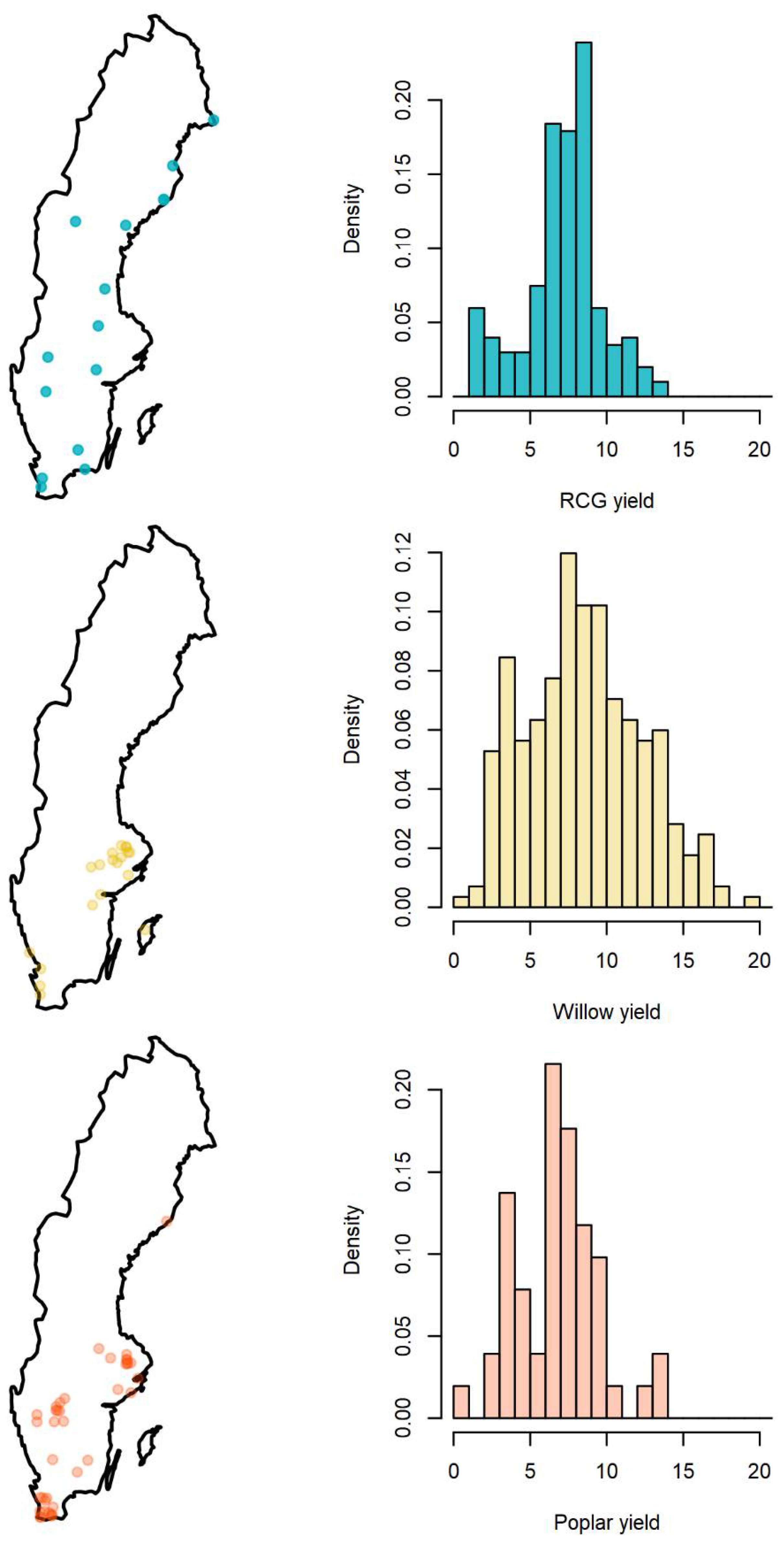
The study analysed the development of Swedish reed canary grass cultivation between 2001 and 2020 and compared it with the country's other major lignocellulosic energy crops: willow and poplar/hybrid aspen. Agricultural registers, commercial statistics, experimental trials, climatic data and spatial analysis were combined to examine not only how much biomass the crop produces, but also where it is actually grown. Reed canary grass was concentrated considerably farther north than willow and poplar, and was associated with colder and generally less productive agricultural land. Mean annual precipitation at reed canary grass sites was approximately 582 mm, compared with 606 mm for willow and 655 mm for poplar/hybrid aspen. The complete analysis of these climatic and spatial patterns is available here.
Despite these less favourable growing conditions, the crop performed surprisingly well. Experimental trials produced average yields of approximately 6 oven-dry tonnes (odt) ha−1 year−1, broadly comparable with willow and poplar trials, while individual observations approached 15 odt ha−1 year−1. The more important lesson, however, emerges when experimental results are compared with commercial agriculture. Actual Swedish production averaged only around 3.4–3.5 odt ha−1 year−1. Harvest losses can be substantial, and effective harvested biomass may represent only around half of the biological yield. The results therefore illustrate why experimental biomass yields should be used cautiously when evaluating commercial energy-crop systems.
The land-use history provides another important part of the story. New reed canary grass fields primarily replaced meadow land and, to a lesser extent, cereal cultivation. But the direction changed when plantations were abandoned: after 2009, former reed canary grass fields increasingly returned to cereal production. This matters environmentally because the consequences of establishing a perennial crop depend strongly on what it replaces. Converting annual cropland may improve soil-carbon dynamics and reduce some agricultural impacts, whereas replacing an existing grassland can produce a very different environmental balance. Land-use trajectories therefore need to be considered alongside biomass yields when assessing energy crops, carbon sequestration or broader ecosystem effects.
Yet again, the clearest signal came from policy. Swedish cultivation expanded rapidly after 2005, reaching around 800 ha in 2009, but subsequently declined to approximately 550 ha. These changes closely followed modifications to agricultural support schemes and incentives for industrial and energy crops. The experience was even more dramatic in Finland, where reed canary grass expanded to tens of thousands of hectares before declining rapidly after policy support changed. Reed canary grass therefore illustrates a broader challenge for the bioeconomy: being biologically suitable does not necessarily make a biomass crop economically sustainable. Farmers require sufficiently predictable markets, management costs and revenues if cultivation is to persist after direct subsidies disappear.
The comparison with willow and poplar is interesting: reed canary grass can achieve similar commercial biomass yields while occupying colder and less agriculturally productive locations, and its establishment costs can be lower because conventional farm equipment can be used. This gives the crop a potentially complementary role rather than making it simply a competitor to woody energy plantations. At the same time, harvesting losses, biomass quality, narrow economic margins and sensitivity to policy incentives remain important limitations. The Swedish experience suggests that successful biomass systems must therefore be evaluated simultaneously as biological, spatial, economic and policy systems.
Further information: Research on biomass production, plantation forestry, energy crops and land-use dynamics is available through the Biomass Production research group at the University of Eastern Finland. Further publications and activities can also be found at sites.uef.fi/biopro.
Reference
Mola-Yudego, B., Xu, X., Englund, O., & Dimitriou, I. (2021). Reed Canary Grass for Energy in Sweden: Yields, Land-Use Patterns, and Climatic Profile. Forests, 12(7), 897. https://doi.org/10.3390/f12070897

0 comments:
Post a Comment