Showing posts with label Bioenergy. Show all posts

What if Europe grew more grass?

A climate-soil strategy

Grass hardly looks like a technological solution to climate change. It grows beside roads, between fields and across millions of hectares of European countryside. Yet its apparent simplicity hides something interesting. Modern agriculture has increasingly specialised in annual crops, and that intensification has come with a legacy of depleted soil carbon, nutrient losses, erosion and other environmental pressures. What would happen if perennial grass were deliberately brought back into crop rotations—not simply as another crop, but as part of the environmental infrastructure of agricultural landscapes? This was the question behind our study, Large-scale deployment of grass in crop rotations as a multifunctional climate mitigation strategy. Instead of looking at a handful of experimental fields, we modelled more than 81,000 sub-watersheds across the EU27 and the United Kingdom, asking where additional grass could make sense and what it might achieve.

The interesting part is that the answer is not only about carbon. Bringing perennial grass into rotations could help rebuild soil organic carbon while simultaneously producing large quantities of biomass and protein. The same change could reduce nitrogen losses to water, limit wind and water erosion and, in some landscapes, contribute to flood mitigation. If some of the harvested grass were processed in green biorefineries, it could also become feed protein, biogas and raw material for other biobased products. In the scenarios explored in the study, the combined annual greenhouse-gas savings from soil-carbon sequestration and replacing natural gas with grass-derived biogas were estimated to be equivalent to roughly 13–48% of current greenhouse-gas emissions from European agriculture. This is not a prediction that such savings will automatically occur: it is a modelled estimate of the scale of the opportunity under widespread deployment. But it reveals an important point. A hectare of agricultural land does not necessarily have to deliver just one service. Managed differently, the same landscape can produce commodities while also storing carbon, protecting soils and improving water quality.

There is, of course, a catch—and it may be the most interesting part of the story. Growing grass is easy; creating an economic system that values everything the grass does is much harder. Farmers need markets for the biomass, biorefineries need investment and reliable supply chains, and environmental benefits such as carbon sequestration or cleaner water need mechanisms that translate them into real incentives. The study therefore points beyond a simple choice between food production and environmental protection. The challenge is to design agricultural and bioeconomy systems in which the two reinforce one another. In that sense, grass becomes more than a crop: it becomes a possible bridge between agriculture, renewable energy, soil restoration and the emerging circular bioeconomy. This connection between biomass production and the wider functions of landscapes is also central to research at the Biomass Production. Further publications and research activities are available here.


Co-benefits of introducing grass production in crop rotations with the primary objective of enhancing soil organic carbon. The figure shows the relative to contribution toward reaching the classification “low impact” at the landscape scale for nitrogen emissions to water, soil loss by water erosion, and soil loss by wind erosion, respectively, in the low-estimate (left) and high-estimate (right) scenarios. Landscapes that already have a “low” or lower impact are excluded.


Read the study

Englund, O., Mola-Yudego, B., Börjesson, P., Cederberg, C., Dimitriou, I., Scarlat, N., & Berndes, G. (2023). Large-scale deployment of grass in crop rotations as a multifunctional climate mitigation strategy. GCB Bioenergy, 15(2), 166–184.

Full-text article: Open-access PDF
Journal: GCB Bioenergy — Wiley
Article page: Wiley Online Library
DOI: https://doi.org/10.1111/gcbb.13015

Can Energy Crops Thrive in the Cold? Development of Reed Canary Grass in Sweden

Can an energy crop remain productive where the climate becomes too cold for many conventional alternatives? Reed canary grass (Phalaris arundinacea L.) provides an interesting test case. This perennial grass is highly tolerant of frost, can grow under relatively difficult soil conditions and can be harvested using conventional agricultural machinery. It has therefore attracted considerable attention as a biomass crop in Northern Europe. But its potential cannot be judged from experimental yields alone. A nationwide assessment of reed canary grass cultivation in Sweden shows how strongly its real-world performance depends on climate, land use, harvesting efficiency and agricultural policy.

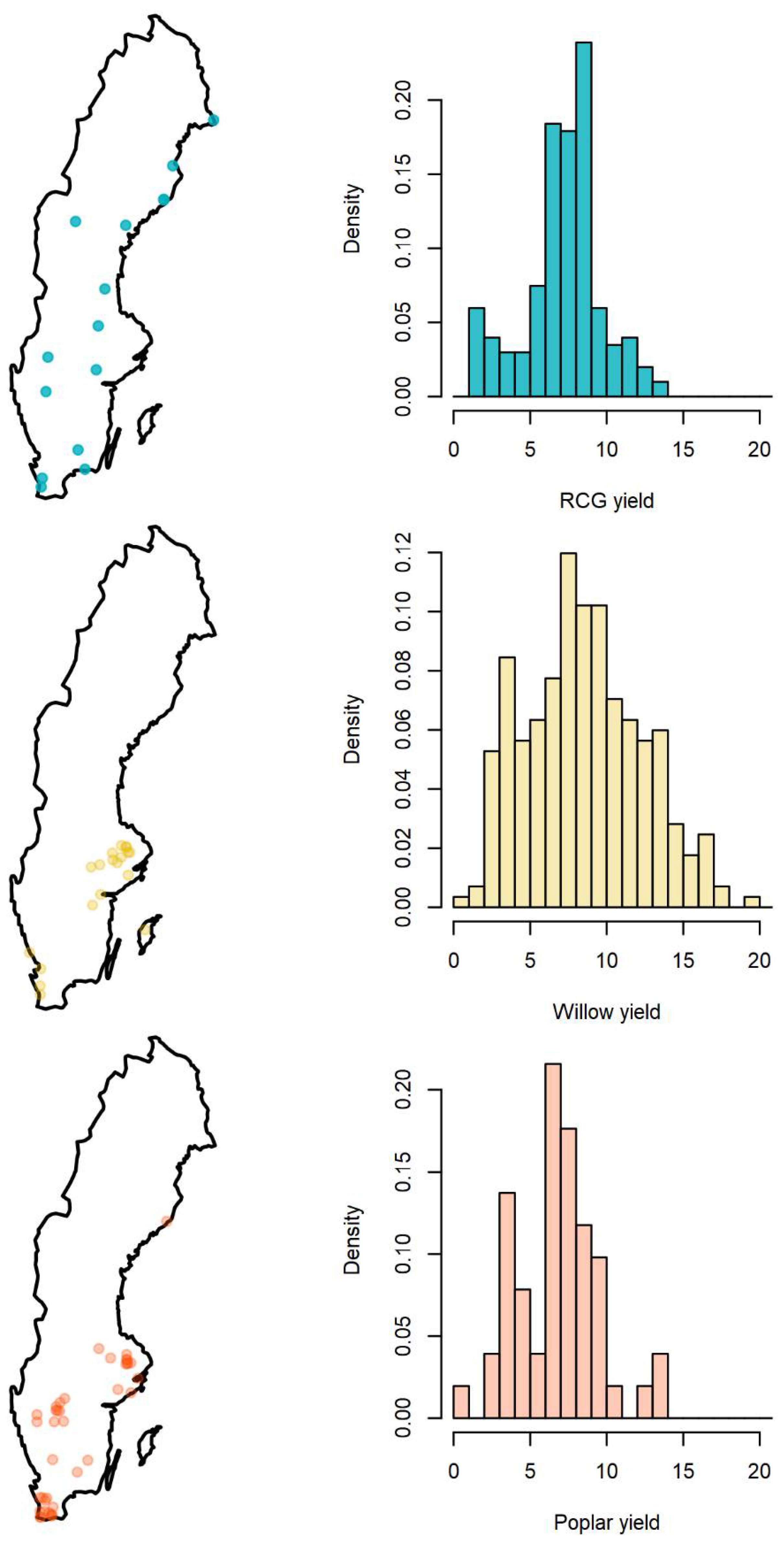
The study analysed the development of Swedish reed canary grass cultivation between 2001 and 2020 and compared it with the country's other major lignocellulosic energy crops: willow and poplar/hybrid aspen. Agricultural registers, commercial statistics, experimental trials, climatic data and spatial analysis were combined to examine not only how much biomass the crop produces, but also where it is actually grown. Reed canary grass was concentrated considerably farther north than willow and poplar, and was associated with colder and generally less productive agricultural land. Mean annual precipitation at reed canary grass sites was approximately 582 mm, compared with 606 mm for willow and 655 mm for poplar/hybrid aspen. The complete analysis of these climatic and spatial patterns is available here.

Despite these less favourable growing conditions, the crop performed surprisingly well. Experimental trials produced average yields of approximately 6 oven-dry tonnes (odt) ha−1 year−1, broadly comparable with willow and poplar trials, while individual observations approached 15 odt ha−1 year−1. The more important lesson, however, emerges when experimental results are compared with commercial agriculture. Actual Swedish production averaged only around 3.4–3.5 odt ha−1 year−1. Harvest losses can be substantial, and effective harvested biomass may represent only around half of the biological yield. The results therefore illustrate why experimental biomass yields should be used cautiously when evaluating commercial energy-crop systems.

The land-use history provides another important part of the story. New reed canary grass fields primarily replaced meadow land and, to a lesser extent, cereal cultivation. But the direction changed when plantations were abandoned: after 2009, former reed canary grass fields increasingly returned to cereal production. This matters environmentally because the consequences of establishing a perennial crop depend strongly on what it replaces. Converting annual cropland may improve soil-carbon dynamics and reduce some agricultural impacts, whereas replacing an existing grassland can produce a very different environmental balance. Land-use trajectories therefore need to be considered alongside biomass yields when assessing energy crops, carbon sequestration or broader ecosystem effects.

Yet again, the clearest signal came from policy. Swedish cultivation expanded rapidly after 2005, reaching around 800 ha in 2009, but subsequently declined to approximately 550 ha. These changes closely followed modifications to agricultural support schemes and incentives for industrial and energy crops. The experience was even more dramatic in Finland, where reed canary grass expanded to tens of thousands of hectares before declining rapidly after policy support changed. Reed canary grass therefore illustrates a broader challenge for the bioeconomy: being biologically suitable does not necessarily make a biomass crop economically sustainable. Farmers require sufficiently predictable markets, management costs and revenues if cultivation is to persist after direct subsidies disappear.

The comparison with willow and poplar is interesting: reed canary grass can achieve similar commercial biomass yields while occupying colder and less agriculturally productive locations, and its establishment costs can be lower because conventional farm equipment can be used. This gives the crop a potentially complementary role rather than making it simply a competitor to woody energy plantations. At the same time, harvesting losses, biomass quality, narrow economic margins and sensitivity to policy incentives remain important limitations. The Swedish experience suggests that successful biomass systems must therefore be evaluated simultaneously as biological, spatial, economic and policy systems.

Further information: Research on biomass production, plantation forestry, energy crops and land-use dynamics is available through the Biomass Production research group at the University of Eastern Finland. Further publications and activities can also be found at sites.uef.fi/biopro.

Reference

Mola-Yudego, B., Xu, X., Englund, O., & Dimitriou, I. (2021). Reed Canary Grass for Energy in Sweden: Yields, Land-Use Patterns, and Climatic Profile. Forests, 12(7), 897. https://doi.org/10.3390/f12070897

Estimated distribution of yields (odt ha−1 year−1) for reed canary grass compared to willow and poplar in different trials along the country (see maps) for the period of 1991–2010.


What Do Fast-Growing Plantations Really Replace? A Better Baseline for energy crop's LCA

Environmental assessments of fast-growing plantations often begin with a deceptively simple assumption: that the plantation replaces an average cereal field. Yet, a realistic baseline is not a technical detail. It is part of the system being assessed. Whether willow, poplar or hybrid aspen replaces winter wheat, spring barley, temporary grassland or fallow land can substantially influence estimates of greenhouse-gas balances, soil carbon, nutrient losses, biodiversity effects and opportunity costs. For this reason, understanding where plantations are established, and what they replace, is essential for credible life-cycle assessment, land-use modelling and bioeconomy planning.

A 30-year assessment of fast-growing plantations in Sweden provides one of the most detailed empirical baselines currently available. The study traced the development of willow, poplar and hybrid aspen plantations between 1986 and 2017, combining plantation records, agricultural land-register data and spatial analysis. The results showed that willow remained the dominant system, but its area declined from approximately 14,000 ha around 2001 to 7,785 ha in 2017. Poplar and hybrid aspen partly offset this decline, reaching 1,738 ha and 676 ha, respectively, by 2017. In total, Sweden still maintained approximately 10,200 ha of fast-growing woody plantations, although their composition, location and agricultural context changed markedly over time. The full analysis is available here.

The results also showed that plantation establishment cannot be separated from changing policies and agricultural markets. Willow expansion was initially linked to Swedish policy support for energy crops, whereas its subsequent decline coincided with reduced incentives and rising cereal prices after 2007. Average cereal prices increased sharply relative to the 1990–2006 period, by approximately 49% for wheat, 40% for barley and 22% for oats. At the same time, many former willow plantations returned to cereal cultivation. However, new plantations were not established only on cereal land. In 2016, new willow plantations were commonly associated with former spring barley, winter wheat, temporary grassland and fallow land. Poplar plantations showed an even clearer association with lower-intensity agricultural land uses, particularly fallow land and temporary grass. These replacement patterns provide a practical basis for defining differentiated reference scenarios.

This distinction matters greatly for LCA. A plantation replacing intensively managed cereal land may generate different environmental trade-offs than one established on fallow land or temporary grassland, where fertiliser use, machinery inputs and baseline carbon dynamics are already lower. Treating all plantation establishment as a cereal-to-wood transition may therefore overestimate some environmental benefits or overlook relevant impacts. Rather than relying on a single generic counterfactual, future assessments could use a weighted portfolio of agricultural reference systems, reflecting the observed shares of cereals, grasses and fallow land replaced by each plantation type. Such an approach would make evaluations of short-rotation woody crops more spatially realistic, more transparent and more relevant for policy.

The study also illustrates that plantation systems are dynamic rather than uniform. Willow plantations increasingly concentrated in southern and more productive agricultural areas, whereas poplar tended to expand on less productive land. Smaller plantation units became more frequent, particularly those below one hectare, while large systems above ten hectares became relatively uncommon. These patterns reflect not only land availability, but also changing farmer preferences, local biomass markets, management choices and wider agricultural conditions. For researchers seeking robust baseline scenarios for plantations, the central message is clear: the environmental performance of a plantation cannot be assessed independently from the land-use trajectory that made it possible.

Further information: Research on biomass production, plantation forestry and land-use dynamics is available through the Biomass Production research group at the University of Eastern Finland. Further publications and activities can also be found at sites.uef.fi/biopro.

Reference

Xu, X., & Mola-Yudego, B. (2021). Where and when are plantations established? Land-use replacement patterns of fast-growing plantations on agricultural land. Biomass and Bioenergy, 144, Article 105921. https://doi.org/10.1016/j.biombioe.2020.105921

For related research, visit the Biomass Production research group, University of Eastern Finland.


Improving woodfuel governance in Burkina Faso: The experts' assessment


AREVALO J. 2016. Improving woodfuel governance in Burkina Faso: The experts' assesment. Renewable and Sustainable Energy Reviews Volume 57, May 2016, Pages 1398–1408 doi:10.1016/j.rser.2015.12.178. 
Over 80% of Sub-Saharan population depend on woodfuels as their main energy source, mainly firewood and charcoal. In Burkina Faso, despite the absence of reliable studies, this dependency is expected to continue and even increase in the next decades. With some of the highest annual population increments and lowest indexes of human development in the world, Burkina Faso is also among the most vulnerable countries to climate change. This study examines the challenges of governance, production and use of woodfuels in Burkina Faso on the basis of an extensive literature review and the views elicited through 13 in-depth interviews with local experts. With poverty as the underlying driver, agricultural expansion is identified as the principle driver of deforestation, followed by woodfuel production. Intensification of agriculture, agroforestry practices and promotion of on non-timber forest product businesses are some of the key opportunities recognised. While decentralisation is seen as an opportunity for sustainable resource management, the lack of resources, unclear tenure regime and corruption need to be urgently addressed. An improved management system in the Forest Management Units is also needed to avoid forest degradation. The 20 concrete recommendations made in the study should be further investigated for their consideration in a future wood energy strategy.
ScienceDirect [link]
ResearchGate [link]

Firewood truck bound to Ouagadougou

Stakeholders’ Perceptions of Bioenergy: Global policy implications

HALDER, P., AREVALO J., MOLA-YUDEGO, B. GRITTEN, D. 2015. Stakeholders’ perceptions of bioenergy- global coverage and policy implications. In: Reddy BS and Ulgiati S (Eds.), Energy Security and Development – The Global Context and Indian Perspectives. pp. 377-391. Springer. ISBN: 978-81-322-2064-0. doi:10.1007/978-81-322-2065-7_25

Abstract
Development of bioenergy systems is gaining momentum globally and bioenergy stakeholders are numerous and their perceptions are diverse. The study explored perceptions of bioenergy stakeholders by reviewing scholarly literature and complementing and validating them against primary data. The number of publications on stakeholders’ perceptions of bioenergy is increasing while geographical focus and stakeholder analysis vary considerably. Among the stakeholders, biomass producers, public, and experts are widely studied groups while the least explored are students and private developers. The majority of the studies have been conducted in North America and Europe, which indicate the importance of bioenergy in their energy policies and the role of stakeholders to influence bioenergy development in those countries. The study found that the stakeholders’ perceptions of bioenergy were not uniform and varied considerably even within a particular stakeholder group. More support for second- and third-generation biofuels is apparent compared to corn-based ethanol production. Factors such as age, gender, education, income level, and land ownership appear to influence stakeholders’ perceptions of bioenergy. The paper recommends raising awareness of bioenergy among different stakeholders and involving them while planning future bioenergy projects to improve their perceptions of bioenergy and reduce the chances of opposition. There is also a need for enhancing collaboration between renewable energy and educational policies so that young students become aware of bioenergy and can act as agents of change in our quest for renewable energies.

Springer [link]
ResearchGate [link]

Substituting fossil fuel by biofuels: an economic model perspective from the Nordic region

article

What makes one energy source replace another? Technology matters, and so does resource availability—but prices, taxes and subsidies can be just as decisive. Our study, Assessing external factors on substitution of fossil fuel by biofuels: model perspective from the Nordic region, explored how economic policy could influence the replacement of fossil fuels by forest-based bioenergy in the Nordic region. Rather than asking only whether enough biomass exists, the study focused on a more practical question: under what economic conditions does switching away from fossil fuels actually become attractive?

The model produced a clear message: policy instruments can reinforce each other. A subsidy for forest biofuels increased modelled biofuel demand and encouraged substitution away from fossil fuels, but the effect became considerably stronger when the subsidy was combined with a fossil-fuel tax. In that scenario, the estimated level of fuel substitution increased by around 31%. These figures are not predictions of what must happen in the real world. Instead, they illustrate the mechanisms at work: even relatively simple changes in relative prices can reshape demand, influence investment decisions and alter the competitiveness of renewable alternatives.

More than a decade later, this question has lost little of its relevance. Europe is simultaneously trying to reduce greenhouse-gas emissions, strengthen energy security and manage its biological resources sustainably. Forest biomass can contribute to this transition, but its role cannot be understood independently of markets, taxation, competing uses of wood and wider forest policy. The challenge is therefore not simply to produce more renewable energy, but to design incentives that encourage substitution where it is economically and environmentally sensible. More research on these questions can be found at the Biomass Production Research Group and on this research website.

KHANAM T, MATERO J, MOLA-YUDEGO B, SIKANEN L, RAHMAN, A. 2014. Assessing external factors on substitution of fossil fuel by biofuels: model perspective from the Nordic regionMitigation and Adaptation Strategies for Global Change. doi:  10.1007/s11027-014-9608-x

Abstract
The aim of this study is to develop a theoretical model by which to demonstrate how taxes and subsidies work as external factors to substitute fossil fuel by a forest-based biofuel. For biofuels, this study predominantly considers solid-form biomass that generates electricity; for fossil fuels, it considers coal. The model results explicated with three states by using various numeric values taken from the literature. Three states are as follows: a situation without a tax and subsidy, a situation with a biofuel subsidy, and a situation with a biofuel subsidy and a fossil fuel tax. The results of the first state exemplify current fuel market situation; those of the second indicate that the aggregate demand for biofuel has shifted upwards by around 15 % and that substitution has increased by around 18 % due to biofuel subsidies being offered. Under the third state, aggregate biofuel demand has shifted upwards by around 19 %, reduced the demand for fossil fuels by around 13 %, and increased substitution by around 31 %. This state relates to a greater sense of social welfare than other two states. It is conceivable that the joint application of taxes and subsidies will succour biofuel to supplant fossil fuel in the near future.

Mitigation and Adaptation Strategies for Global Change at Springer Link [link]
ResearchGate [link]
Social welfare at different circumstances


How to introduce successfully energy crops?

 article

How to introduce energy crops and get success? The journal Renewable Energy has recently published our paper on a framework for the introduction of energy crops. In this paper, we review the different steps linked to the introduction of short rotation plantations in Sweden during the last 30 years, and include a review of our previous work as well as other authors. The final result is a conceptual framework that displays the many inter-relations between different stakeholders as well as policy actors, and provides some ideas about how to proceed when new energy crops are considered. The sources include data from existing commercial plantations, results from experimental plots, the profile of farmers adopting the plantation systems, and a review of existing economic studies on profitability and the policy framework during the period studied.

MOLA-YUDEGO B, DIMITRIOU I, GONZALEZ-GARCIA S, GRITTEN D, ARONSSON P. 2014. A conceptual framework for the introduction of energy crops. Renewable Energy 72: 29-38. Doi: 10.1016/j.renene.2014.06.012

Highlights
•The paper analyses the introduction of willow plantations for energy in Sweden in 1986–2005.
•A framework is presented to identify factors and its inter-relations.
•The framework is based on a large pool of data of growers and plantations.
•Stable policies and long-term contracts are key elements for success.

Abstract
There is currently limited experience on the introduction of new commercial crops as a source of raw material for energy uses. The present paper analyses the introduction and development of commercial willow plantations in Sweden during the period 1986–2005. A general framework is constructed in order to identify all the factors and interrelations that can describe the introduction and expansion of willow as an alternative crop for the production of raw material for energy. The factors are identified and analysed based on a broad database of information from commercial plantations, covering almost all existing plantations, and on documents referring to existing academic literature or official reports. The analysis provides with lessons that can be useful for the introduction of new energy crops in other countries and shows the possible contradictions in policy applications. The analysis confirms that stable policies and long-term contracts reduce the uncertainties associated with the cultivation. The results of this study can be of value for other countries aiming at the introduction of new crops for bioenergy.

Renewable Energy at Science Direct [link]
ResearchGate [link]

Understanding bioenergy conflicts: Case of a jatropha project in Kenya’s Tana Delta

Bioenergy is often presented as a double opportunity, to reduce dependence on fossil fuels while also promoting rural development. But large-scale bioenergy projects do not unfold in empty landscapes. They enter places with existing land uses, rights, institutions, and histories of inequality. When those realities are ignored, a project framed as green development can rapidly become a source of conflict.

In this paper, we examined the case of a proposed large jatropha plantation in Kenya’s Tana Delta, using Ethical Analysis to understand the positions, interests, and values of the main stakeholders. The case was not only about biodiesel. It was also about who has the right to decide over land, whose livelihoods count, and how “development” itself is understood by different actors.

What we found was that the conflict was structured around four major issues: land tenure, trade-offs between economic and environmental benefits, representation and power relations, and different approaches to development and sustainability. Some actors emphasized jobs, investment and local growth. Others stressed biodiversity, grazing rights, traditional land uses, and the risks of weakly regulated land deals. The disagreement, therefore, was not simply about being for or against bioenergy, but about what kind of rural future was being imposed, and for whom.

Perhaps the most important message was that many of the tensions could have been anticipated. The study identified shortcomings in technical feasibility studies, limited community participation, weak consultation processes, and an insufficient regulatory framework. In that sense, the problem was not only the crop or the investor, but the broader governance setting that allowed such a project to move forward without properly addressing land tenure, local rights, and competing claims over the landscape.

For me, this is where the study still feels very relevant. If hashtag#bioenergy is to contribute to hashtag#climate goals and hashtag#development, it cannot rely only on promises of investment or emission reductions. It also needs credible feasibility, transparent institutions, and meaningful participation from the start. The paper points to Free, Prior and Informed Consent, stronger oversight, and better policy coordination as necessary steps. That is a simple but important lesson for hashtag#policy and hashtag#governance: sustainability is not only about the final product, but also about the process through which land use decisions are made.

Arevalo, J., Ochieng, R., Mola-Yudego, B., & Gritten, D. (2014). Land Use Policy, 41, 138–148. https://doi.org/10.1016/j.landusepol.2014.05.002

Can we get good quality timber from Eucalyptus? Coppice-with-standards plantations in Brazil

Eucalyptus plantations are a very important source for biomass. In recent years, there have been important developments increasing the efficiency of the production and at the same time diversifying the future uses of the wood, including timber. The present paper is reviewing some of the silvicultural treatments proposed and used in Brazil:

FERRAZ FILHO A, SCOLFORO J RS, MOLA-YUDEGO B. 2014. Coppice with standards silvicultural system applied to Eucalyptus plantations - a review. Journal of Forestry Research 25(2):237-248.


Abstract: We review the management of Eucalyptus species under a coppice-with-standards (CWS) silvicultural system. CWS management results in product diversification, permitting production of small and large scale timber from the same stand. Eucalyptus species are suitable candidates for CWS management because: there are large worldwide plantation areas, sprouting capacity is high, and eucalypts are multipurpose species. We discuss (1) short rotation Eucalyptus coppice management for energy and pulping and (2) Eucalyptus seedling management for solid wood products. We review the literature and discuss experiences with Eucalyptus managed under the CWS system. We also assess projects dealing with Eucalyptus coppice management, stand density regulation, pruning, and stand and wood quality. The growth environment of the standard trees (heavy competition up to the first harvest, free growth afterwards) coupled with long rotations (>20 years) results in high quality logs for solid wood products. Early pruning should be applied to enhance wood quality. We propose a system for the silvicultural management of Eucalyptus under the CWS system, elaborating on the consequences of initial planting density, site productivity, and standard tree densities as well as timing of basic silvicultural applications.

Keywords: stand density regulation, coppice management, pruning,  silvicultural system, stand production diversification, CWS


Journal of Forestry Research [link]
ResearchGate [link]

Developing forestry curricula: experiences from a Kenyan- Finnish project

The International Forestry Review journal has published our paper on forestry capacity development in Kenya. The paper details the process of the curriculum review undertaken at the University of Eldoret in collaboration with the University of Eastern Finland. The need analysis carried out revealed which were the subject-specific and generic competencies needing more attention, allowing for the prioritization of these areas in the review. Not surprisingly, among them was the area of bioenergy.

AREVALO, J., PITKÄNEN, S. & KIRONGO, B. 2014. Developing forestry curricula:experiences from a Kenyan-Finnish project. International Forestry Review, 16 (1) 78 86(9)


Abstract

In the context of the challenges that forestry education faces, the improvement of curricula to increase its attractiveness and address the changing needs of the society is imperative. With the aim of improving the forestry education offered at the University of Eldoret in Kenya, a joint project was carried out together with the University of Eastern Finland during 2011–2012. One of the tasks of the project was to revise the curriculum of the undergraduate programme in forestry. According to the needs assessment, the biggest gaps in subject-specific competencies were in areas such as forest information systems and forests and climate change, as well as in generic competencies such as computer skills. The need to update and expand contents (e.g. on dryland forestry) and learning methods (e.g. more practicals) clearly emerged. The proposed changes in the context of various initiatives to improve forestry education in Kenya and worldwide are discussed. 

Keywords

forestry education; curriculum development; competencies; employability

International Forestry Review Journal at Ingenta Connect [link]
ResearchGate [link]

Cradle-to-gate Life Cycle Assessment of forest operations

The journal Journal of Cleaner Production has published our paper on Life Cycle Assessment of forest operations in Europe. The paper review different operations mostly concerning plantations in different countries. The future use of plantations should focus also in the environmental effects of their management, in addition to the traditional focus on yield and profitability. This paper aims to set a common ground for comparison, despite the many and diverse management regimes that are used in plantations.

GONZÁLEZ-GARCÍA, FEIJOO G, MOREIRA M T, MOLA-YUDEGO B. 2014. Cradle-to-gate Life Cycle Assessment of forest operations in Europe. Environmental and Energy consequences. Journal of Cleaner Production. In Press. http://dx.doi.org/10.1016/j.jclepro.2013.11.067.


Abstract

Life Cycle Assessment (LCA) has become a common and standardized methodology to evaluate the environmental profiles of forest systems. In this study twelve different European forest systems dedicated to wood production for industrial or energy uses (maritime pine, spruce, willow, poplar and Douglas-fir) were compared in detail from environmental and energy points of view considering a cradle-to-gate perspective. The scenarios included the silviculture of these tree species in Sweden, Germany, France, Italy and Portugal. A database with inventory data was constructed for each scenario. The scenarios considered were standardized using the same methodological life cycle assumptions in order to establish comparisons for an overall analysis.

The results show a relatively wide range of variations in terms of biomass productivities as well as environmental and energy profiles. These variations depended on the tree species, management regime (different levels of fertilization, time of harvesting and intensity of forest operations) and the overall conditions of the location of the plantations. However, regardless of the scenario considered, operations related to logging such as harvesting and forwarding were identified as hotspots mainly due to the remarkable fuel requirement. Fertilization activities and fertilizer production (when required), thinning processes (when necessary) as well as weed control related processes reported also notable contributions to the categories under assessment.

If these twelve scenarios are compared with other similar studies for the same tree species, significant differences can be found which are mainly linked to different forest management regimes and regional characteristics.

The choice and the promotion of a specific forest biomass for industrial applications should not only depend on the biomass yield and the harvesting age but it should be also based on the intensity of forest practices since it considerably affects the environmental and energy profiles.

Keywords

Douglas-fir; Maritime pine; Norway spruce; Poplar; Wood biomass; Willow plantations


Journal of Cleaner Production at Science Direct [link]
ResearchGate [link]

Wood pellet production clusters

The journal Renewable Energy, has recently posted our latest paper on pellet production. The paper identifies the location of most of the major pellet producer plants in Europe, and makes a geo-statistical analysis of them. This method helps us to identify those production clusters as well as those areas where the production is more concerntrated and dominated by few producers, and also the extend and main characteristics of the European pellet markets.

MOLA-YUDEGO B, SELKIMÄKI M, GONZALEZ-OLABARRIA J R. 2013. Spatial analysis of the wood pellet production for energy in Europe. Renewable Energy. Doi: 10.1016/j.renene.2013.08.034.

Abstract

The distribution of the wood pellet plants in Europe was analysed using a geo-statistical kernel based approach, in order to identify and define cluster-regions with high concentration of pellet production capacity. For that, a database with the location of pellet plants, as well as its capacity, was constructed, identifying 378 pellet plants with annual capacities over 1000 t, and an aggregated production of 11.5 million t. The geo-statistical methods facilitated the analysis of the plants with regards to their market position at global and local level.

At a European level, four main production areas were identified, defined as: “Central Europe” (Bavaria, Austria, and neighbouring areas of France, Switzerland and Italy), “Scandinavia”, “Finland”, and the “Baltic”. These areas concentrated over 50% of the pellet production, although presented different characteristics regarding market establishment and development, their role in the global pellet trade and their raw material availability. The paper provides with methodological tools to identify and characterise the main pellet production areas in Europe that can have further economic and policy applications.

Keywords

Pellet trade; Bioenergy; Kernel models; Supply; Energy; Bioenergy


Renewable Energy at Science Direct [link]
ResearchGate [link]