Can Energy Crops Thrive in the Cold? Development of Reed Canary Grass in Sweden

Can an energy crop remain productive where the climate becomes too cold for many conventional alternatives? Reed canary grass (Phalaris arundinacea L.) provides an interesting test case. This perennial grass is highly tolerant of frost, can grow under relatively difficult soil conditions and can be harvested using conventional agricultural machinery. It has therefore attracted considerable attention as a biomass crop in Northern Europe. But its potential cannot be judged from experimental yields alone. A nationwide assessment of reed canary grass cultivation in Sweden shows how strongly its real-world performance depends on climate, land use, harvesting efficiency and agricultural policy.

The study analysed the development of Swedish reed canary grass cultivation between 2001 and 2020 and compared it with the country's other major lignocellulosic energy crops: willow and poplar/hybrid aspen. Agricultural registers, commercial statistics, experimental trials, climatic data and spatial analysis were combined to examine not only how much biomass the crop produces, but also where it is actually grown. Reed canary grass was concentrated considerably farther north than willow and poplar, and was associated with colder and generally less productive agricultural land. Mean annual precipitation at reed canary grass sites was approximately 582 mm, compared with 606 mm for willow and 655 mm for poplar/hybrid aspen. The complete analysis of these climatic and spatial patterns is available here.

Despite these less favourable growing conditions, the crop performed surprisingly well. Experimental trials produced average yields of approximately 6 oven-dry tonnes (odt) ha−1 year−1, broadly comparable with willow and poplar trials, while individual observations approached 15 odt ha−1 year−1. The more important lesson, however, emerges when experimental results are compared with commercial agriculture. Actual Swedish production averaged only around 3.4–3.5 odt ha−1 year−1. Harvest losses can be substantial, and effective harvested biomass may represent only around half of the biological yield. The results therefore illustrate why experimental biomass yields should be used cautiously when evaluating commercial energy-crop systems.

The land-use history provides another important part of the story. New reed canary grass fields primarily replaced meadow land and, to a lesser extent, cereal cultivation. But the direction changed when plantations were abandoned: after 2009, former reed canary grass fields increasingly returned to cereal production. This matters environmentally because the consequences of establishing a perennial crop depend strongly on what it replaces. Converting annual cropland may improve soil-carbon dynamics and reduce some agricultural impacts, whereas replacing an existing grassland can produce a very different environmental balance. Land-use trajectories therefore need to be considered alongside biomass yields when assessing energy crops, carbon sequestration or broader ecosystem effects.

Yet again, the clearest signal came from policy. Swedish cultivation expanded rapidly after 2005, reaching around 800 ha in 2009, but subsequently declined to approximately 550 ha. These changes closely followed modifications to agricultural support schemes and incentives for industrial and energy crops. The experience was even more dramatic in Finland, where reed canary grass expanded to tens of thousands of hectares before declining rapidly after policy support changed. Reed canary grass therefore illustrates a broader challenge for the bioeconomy: being biologically suitable does not necessarily make a biomass crop economically sustainable. Farmers require sufficiently predictable markets, management costs and revenues if cultivation is to persist after direct subsidies disappear.

The comparison with willow and poplar is interesting: reed canary grass can achieve similar commercial biomass yields while occupying colder and less agriculturally productive locations, and its establishment costs can be lower because conventional farm equipment can be used. This gives the crop a potentially complementary role rather than making it simply a competitor to woody energy plantations. At the same time, harvesting losses, biomass quality, narrow economic margins and sensitivity to policy incentives remain important limitations. The Swedish experience suggests that successful biomass systems must therefore be evaluated simultaneously as biological, spatial, economic and policy systems.

Further information: Research on biomass production, plantation forestry, energy crops and land-use dynamics is available through the Biomass Production research group at the University of Eastern Finland. Further publications and activities can also be found at sites.uef.fi/biopro.

Reference

Mola-Yudego, B., Xu, X., Englund, O., & Dimitriou, I. (2021). Reed Canary Grass for Energy in Sweden: Yields, Land-Use Patterns, and Climatic Profile. Forests, 12(7), 897. https://doi.org/10.3390/f12070897
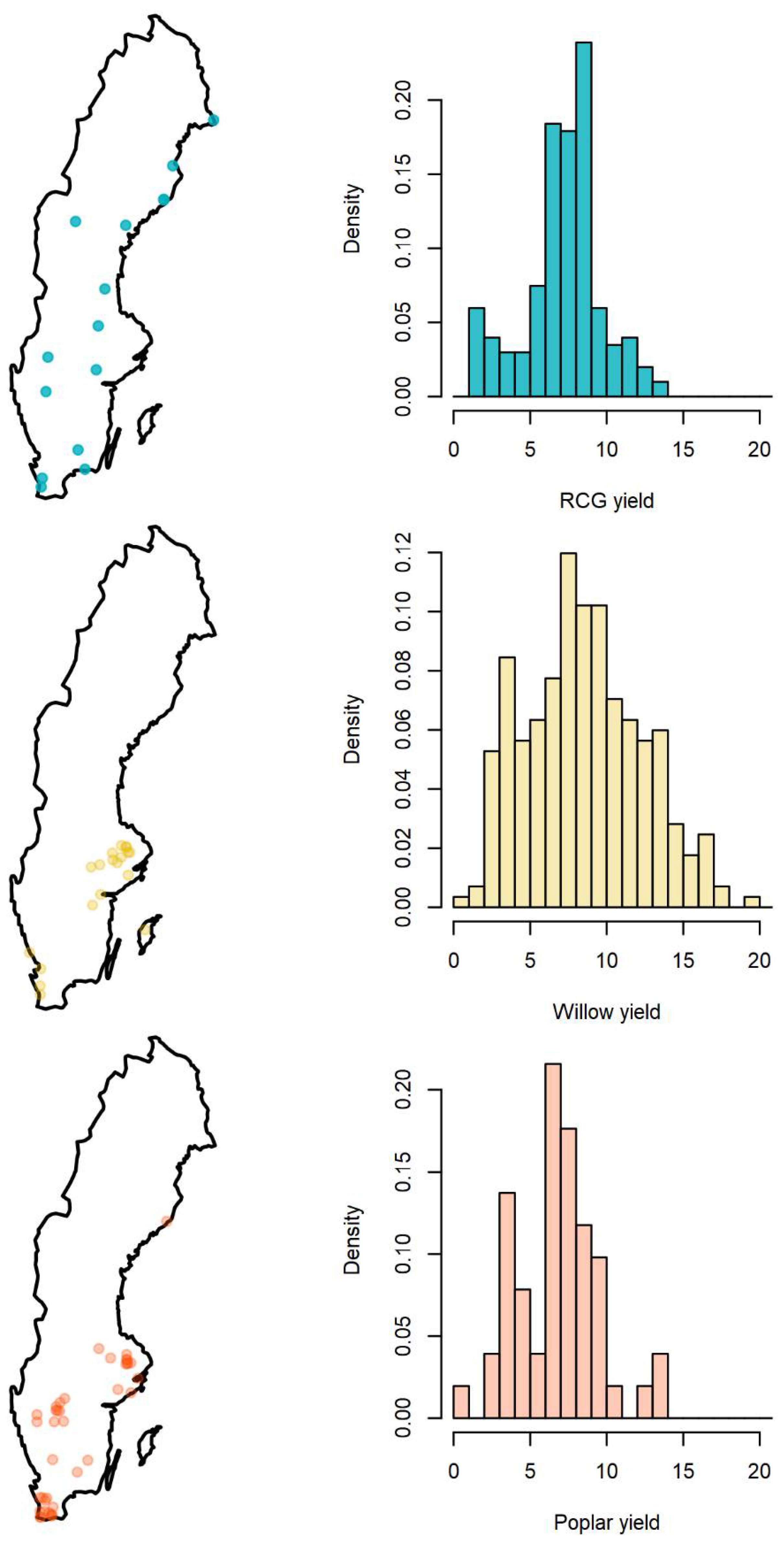
Estimated distribution of yields (odt ha−1 year−1) for reed canary grass compared to willow and poplar in different trials along the country (see maps) for the period of 1991–2010.


What Do Fast-Growing Plantations Really Replace? A Better Baseline for energy crop's LCA

Environmental assessments of fast-growing plantations often begin with a deceptively simple assumption: that the plantation replaces an average cereal field. Yet, a realistic baseline is not a technical detail. It is part of the system being assessed. Whether willow, poplar or hybrid aspen replaces winter wheat, spring barley, temporary grassland or fallow land can substantially influence estimates of greenhouse-gas balances, soil carbon, nutrient losses, biodiversity effects and opportunity costs. For this reason, understanding where plantations are established, and what they replace, is essential for credible life-cycle assessment, land-use modelling and bioeconomy planning.

A 30-year assessment of fast-growing plantations in Sweden provides one of the most detailed empirical baselines currently available. The study traced the development of willow, poplar and hybrid aspen plantations between 1986 and 2017, combining plantation records, agricultural land-register data and spatial analysis. The results showed that willow remained the dominant system, but its area declined from approximately 14,000 ha around 2001 to 7,785 ha in 2017. Poplar and hybrid aspen partly offset this decline, reaching 1,738 ha and 676 ha, respectively, by 2017. In total, Sweden still maintained approximately 10,200 ha of fast-growing woody plantations, although their composition, location and agricultural context changed markedly over time. The full analysis is available here.

The results also showed that plantation establishment cannot be separated from changing policies and agricultural markets. Willow expansion was initially linked to Swedish policy support for energy crops, whereas its subsequent decline coincided with reduced incentives and rising cereal prices after 2007. Average cereal prices increased sharply relative to the 1990–2006 period, by approximately 49% for wheat, 40% for barley and 22% for oats. At the same time, many former willow plantations returned to cereal cultivation. However, new plantations were not established only on cereal land. In 2016, new willow plantations were commonly associated with former spring barley, winter wheat, temporary grassland and fallow land. Poplar plantations showed an even clearer association with lower-intensity agricultural land uses, particularly fallow land and temporary grass. These replacement patterns provide a practical basis for defining differentiated reference scenarios.

This distinction matters greatly for LCA. A plantation replacing intensively managed cereal land may generate different environmental trade-offs than one established on fallow land or temporary grassland, where fertiliser use, machinery inputs and baseline carbon dynamics are already lower. Treating all plantation establishment as a cereal-to-wood transition may therefore overestimate some environmental benefits or overlook relevant impacts. Rather than relying on a single generic counterfactual, future assessments could use a weighted portfolio of agricultural reference systems, reflecting the observed shares of cereals, grasses and fallow land replaced by each plantation type. Such an approach would make evaluations of short-rotation woody crops more spatially realistic, more transparent and more relevant for policy.

The study also illustrates that plantation systems are dynamic rather than uniform. Willow plantations increasingly concentrated in southern and more productive agricultural areas, whereas poplar tended to expand on less productive land. Smaller plantation units became more frequent, particularly those below one hectare, while large systems above ten hectares became relatively uncommon. These patterns reflect not only land availability, but also changing farmer preferences, local biomass markets, management choices and wider agricultural conditions. For researchers seeking robust baseline scenarios for plantations, the central message is clear: the environmental performance of a plantation cannot be assessed independently from the land-use trajectory that made it possible.

Further information: Research on biomass production, plantation forestry and land-use dynamics is available through the Biomass Production research group at the University of Eastern Finland. Further publications and activities can also be found at sites.uef.fi/biopro.

Reference

Xu, X., & Mola-Yudego, B. (2021). Where and when are plantations established? Land-use replacement patterns of fast-growing plantations on agricultural land. Biomass and Bioenergy, 144, Article 105921. https://doi.org/10.1016/j.biombioe.2020.105921

For related research, visit the Biomass Production research group, University of Eastern Finland.


Mapping yields of energy crops in Northern Europe

Willow plantations have long been considered a promising option for #bioenergy in northern Europe. But a basic question remains essential for both investors and #policy makers: how much biomass can actually be produced, and where. It is easy to speak about potential in general terms, but supply planning requires something much more concrete, spatially explicit estimates grounded in real production data.

In this study, we used harvesting records from 1,790 commercial willow plantations in Sweden and combined them with climatic variables to estimate productivity across northern Europe. Rather than relying only on experimental plots, the work was based on commercial plantations, which makes the estimates closer to the biomass that can realistically be harvested and mobilised in practice. The models were then extended to Sweden, Norway, Denmark, Finland, Estonia, Latvia, Lithuania, and the Baltic coastal areas of Germany and Poland.

What we found was a strong spatial variability in yield potential. Precipitation during the growing season, together with key temperature variables, explained an important part of that variation. Under high-performance conditions, average first-rotation yields were above 7 odt ha⁻¹ yr⁻¹ in the Baltic coast of Germany, above 6 in Denmark, above 5 in the Baltic coast of Poland, and between 4 and 5 in much of the remaining study area. This matters because it shows that not all land, and not all regions, offer the same opportunity for energy crops, even within relatively similar climatic zones.

This is, in my view, where the practical value of the study lies. Biomass strategies should not be discussed only in terms of total land availability, but also in terms of realistic productivity, regional differences, and the climatic limits of the crop. Better spatial estimates can improve hashtag#energysystems planning, reduce overly optimistic assumptions, and support more informed decisions on where willow can be a viable part of the renewable energy mix.

At the same time, the study also reminded us of something important: climate explains much, but not everything. Soil conditions, clone choice, and management still matter greatly, especially in the most productive plantations. In that sense, these maps should not be read as fixed truths, but as a solid reference for planning, comparison, and future improvement. For #bioeconomy and #renewableenergy, that is already a very useful step forward.

Download the TIF layers:

gcbb12332-sup-0001-FigS1.tifTIFF image, 5.9 MBFigure S1. Yield estimates based on climatic variables at 1 × 1 km resolution for willow plantations on agricultural areas of northern Europe for a lowest performance scenario.
gcbb12332-sup-0002-FigS2.tifTIFF image, 5.9 MBFigure S2. Yield estimates based on climatic variables at 1 × 1 km resolution for willow plantations on agricultural areas of northern Europe for a middle performance scenario.
gcbb12332-sup-0003-FigS3.tifTIFF image, 5.5 MBFigure S3. Yield estimates based on climatic variables at 1 × 1 km resolution for willow plantations on agricultural areas of northern Europe for a highest performance scenario.
gcbb12332-sup-0004-Appendix.docxWord document, 249.7 KBAppendix S1. Average yield response (marginal effect) by climatic variable.


Source: Mola-Yudego, B., Rahlf, J., Astrup, R., & Dimitriou, I. (2016). Spatial yield estimates of fast-growing willow plantations for energy based on climatic variables in northern Europe. GCB Bioenergy, 8, 1093–1105. https://doi.org/10.1111/gcbb.12332

Yield estimates of energy crops in the Nordic area, Mola-Yudego et al., 2015. https://doi.org/10.1111/gcbb.12332 Willow, energy crops, fast growing plantations, Europe